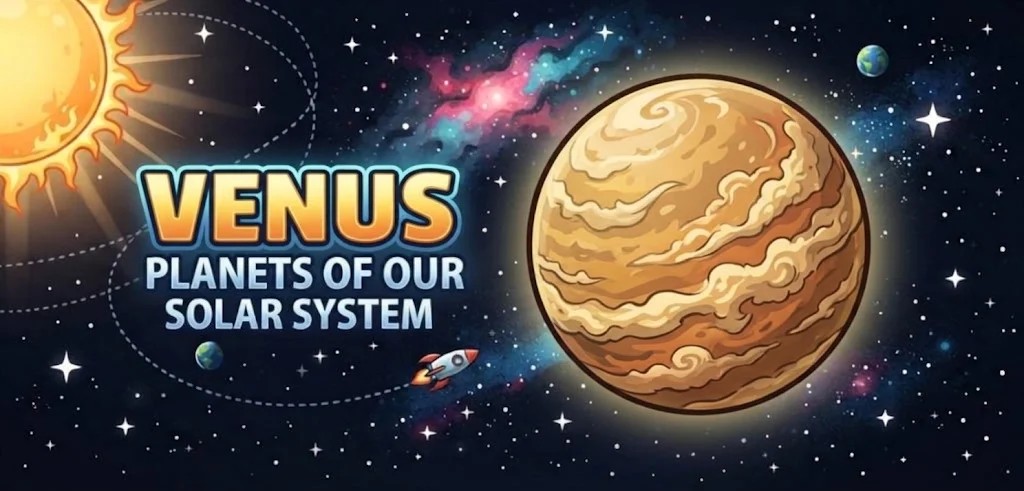
PLANETS OF OUR SOLAR SYSTEM - VENUS
Learning about the Solar System is essential for inspiring youth aged 10 to 17 to explore the universe and activate their curiosity about future scientific discoveries. Every interested young mind today has the potential to become tomorrow's scientist, helping us better understand our place in the universe.
At the heart of this journey is Venus, the brightest planet in our night sky and a world wrapped in thick, swirling clouds of sulfuric acid. Known for its scorching greenhouse temperatures—hotter than Mercury despite being farther from the Sun—crushing atmospheric pressure, and backward rotation, this enigmatic rocky world with no moons or rings offers an exciting step into the mysteries of planetary science.
Upon completion of this Module 1, participants will be able to:
a) Recognize Venus as second planet from the Sun and the hottest in the Solar System because high amount of carbon dioxide which traps heat inside it.


To provide children with information and knowledge about the Planet Venus is to open a window into the secrets of our cosmic neighborhood. By learning how planets form, move, and change over time, children begin to understand that the universe is full of stories waiting to be explored. Shrouded in dense clouds of sulfuric acid and blazing as the hottest world in our solar system, Venus offers a fascinating starting point. Studying its runaway greenhouse effect, crushing atmospheric pressure, and unique backward spin sparks curiosity and encourages thoughtful questions that inspire the next generation of space explorers to unlock the mysteries of the universe.
Note:
If you are interested to be registered on the following course, please complete the application form with your personal information making click on the REGISTRATION button below and send it to receive a User & Password.

*Upon completion of the selected course, participants must take a final assessment in order to obtain their academic certificate, and they will have one hour to complete the assessment as well as two opportunities to pass it.
Availability: 2026-11-22 from to 2026-12-31
Mode: ONLINE RECORDED
Topics: 2
Lecturers: 2
Vacancies: 50