MARS GEOLOGY
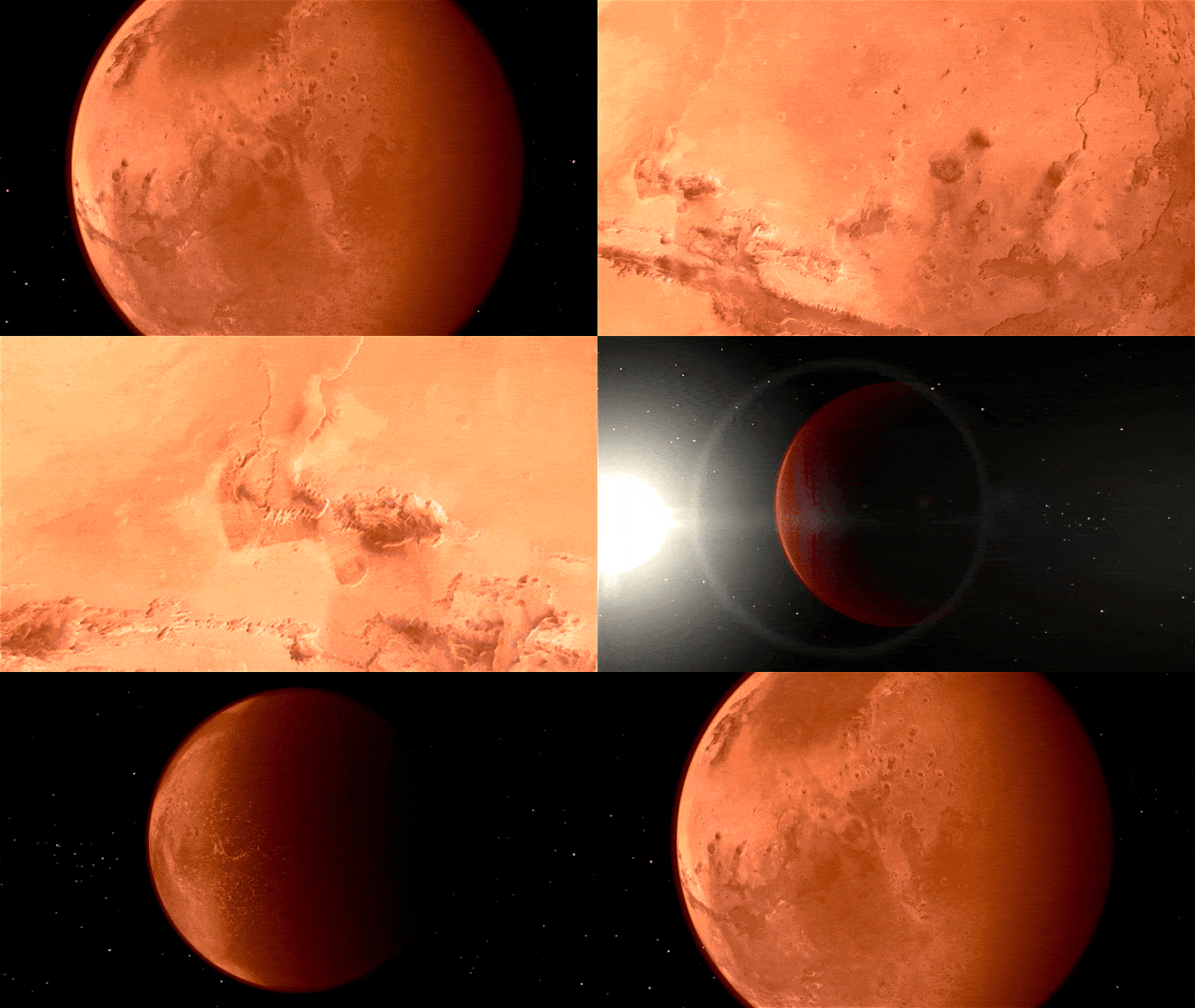
The Geology of Mars is scientific study of the surface, crust and interior of the planet Mars, considering the composition, structure, history and physical processes that shape the planet, where cratering has been the most common process due to meteorite impacts, and partial or complete volcanism cannot be excluded. Therefore, taking into consideration the similarity of Mars with the planet Earth in many aspects, with characteristics such as mountains, valleys and impact craters as well as unique geological characteristics that distinguish it from Earth.
b) Describe the basic geomorphology and mineralogy related to the water activity.
c) Understand the method on how to identify hydrated minerals.
d) Understanding of the mineralogy and geological evolution of Mars.
e) Describe the recent progress from China’s Tianwen-1 mission.
Professor at the National Space Science Center (NSSC) of the Chinese Academy of Sciences (CAS). Expertise at Planetary Spectroscopy, Planetary Composition, Planetary Surface Processes, Mars Geology and Lunar Geology.
Upon completion Topic 2, participants will be able to:
a) Understand the Mars' geology and the definition of volcanism.
b) Describe the Martian landscape, including the different types of volcanoes found on the planet.
c) Describe the characteristics of shield volcanoes, Tharsis Montes, and Olympus Mons, along with evidence for volcanic activity on Mars and the effects of volcanic eruptions on the Martian landscape.
d) Define the comparison between Martian and Earth volcanism and possible implications of Martian volcanism for past and present habitability and the planet's evolution.
Professor at the China University of Geosciences (WUHAN). Expertise at Planetary Geology and Comparative Planetology.
Upon completion Topic 3, participants will be able to:
a) Describe the major scientific discoveries of the scientific payload-radar used for exploring the subsurface structure of Mars.
b) Understand the radar's research on the internal structure and composition of the polar ice caps on Mars.
c) Define the discovery of underground lakes and other possible explanations beneath the South Pole ice cap by the radar.
d) Describe the detection of subsurface water ice in mid to high latitudes on Mars, and the radar's revelation of buried structures such as paleo-lake sediments and paleo-channels.

Professor at the Space Science Institute (SSI) of the Macau University of Science and Technology (MUST). Researcher in Computer Architecture and Planetary Science. Recent publication “Weak Dust Activity near a Geologically Young Surface revealed by Chang E‐3 Mission”.
Upon completion Topic 4, participants will be able to:
a) Define the wind regime and particles of Mars.
b) Describe the typical Martian aeolian landforms, including yardangs, dunes, TARs and ventifacts.
c) Understanding the comparison between Martian and Earth aeolian landforms and possible implications of Martian aeolian landforms for past and present climate.
Professor at the China University of Geosciences (WUHAN). Recent publication “Recent Aqueous Activity on Mars evidenced by transverse Aeolian Ridges in the Zhurong exploration region of Utopia Planitia”.
Upon completion Topic 5, participants will be able to:
a) Describe the magnetism of terrestrial bodies in the solar system and focuses on the magnetic field of Mars.
b) Understanding the application of paleomagnetism in studying the ancient magnetic field of Mars using Martian meteorites.
c) Define the Martian crustal magnetic field, including the crustal magnetic field measurements, the properties of the crustal field, and the relationship between the Martian magnetic field and geological structures.
d) Describe the ancient Martian dynamo field, including the timing and properties of the dynamo, the generation mechanism and reasons for magnetic field attenuation and disappearance.
e) Understanding the significance and value of studying the Martian magnetic field and look forward to future research directions and challenges.
Professor researcher at the Shanghai Astronomical Observatory of the Chinese Academy of Sciences.
Upon completion of this Topic 6, participants will be able to:
a) Describe the astrobiology including its history and research topics.
b) Define the Mars' special regions and habitability studies, prompting the audience to consider whether life could exist or have existed on Mars, and how we can search for it.
c) Understanding the various methods and techniques used to identify potential signs of life, using case studies based on comparative planetology.
d) Describe the importance of studying extreme environments on Earth to understand life's boundaries and potential lifestyles beyond our planet.
e) Understanding the concept of astrobiology on Mars and the tools used to study astrobiology.
Ph.D. at Planetary Geology and Comparative Planetology of China University of Geosciences (WUHAN). Degree on Exploration Technology and Engineering of Guilin University of Technology. Postdoctoral Researcher at the Macau University of Science and Technology (MUST).
Upon completion Topic 7, participants will be able to:
a) Describe the characteristics of predominant surface processes during different geological periods on Mars.
b) Understanding the experimental studies on the sedimentary processes, impact processes, aeolian processes and so forth, to demonstrate how the experimental simulations (along with the thermodynamical and numerical simulations) can aid our understanding on the alteration and evolution of the surface materials on Mars.
Research Center for Planetary Science. CHENGDU University of Technology (CDUT)
Evaluate the participant's understanding of the geological processes, characteristics, and history of Mars, as well as their ability to apply this knowledge to future studies and experiments.

To provide guidance and information on the geological history, composition, and processes that shape the surface of Mars, as well as topics related to volcanism, tectonics, impact cratering, and the role of water and wind in shaping the landscape. We also explore the study of Martian meteorites and the planet's climatic history. Ultimately, we seek to improve our understanding of the geological evolution of Mars.
Note:
If you are interested to be registered on the following course, please complete the application form with your personal information making click on the REGISTRATION button below and send it to receive a User & Password.

*Upon completion of the selected course, participants must take a final assessment in order to obtain their academic certificate, and they will have one hour to complete the assessment as well as two opportunities to pass it.
Availability: 2026-01-01 from to 2026-12-31
Mode: ONLINE RECORDED
Topics: 8
Lecturers: 8
Vacancies: 50